

Why Does Your Brain Get Stuck in Fight or Flight? (And How to Finally Break Free)
Do you feel like your body is always braced for something even when nothing is actually wrong? Like you're living with a low hum of dread, your heart a little too quick, your jaw clenched and tight, your mind scanning for the next threat or worry before the last one has even passed?
If that sounds familiar, your brain may be stuck in fight or flight mode and you are far from alone.
Millions of people walk through their lives in a chronic state of stress activation, unable to fully relax, unable to feel safe, unable to switch off. The frustrating part? Knowing you should be fine doesn't make your nervous system believe it.
In this post, we're going to break down exactly why the brain gets stuck in fight or flight, what it's doing to your body and mind and most importantly what you can actually do to begin to shift it.
What Is the Fight or Flight Response?
The fight or flight response is your body's built in survival system. When your brain perceives a threat whether that's a car swerving into your lane, a confrontation with your boss, or even a stressful text message, it triggers an immediate cascade of physical and chemical changes designed to keep you alive.
Your amygdala (the brain's alarm centre) fires off a distress signal. Your body floods with cortisol and adrenaline. Your heart rate spikes, your breathing shallows, your muscles tense and your digestion pauses. Every non essential system goes offline so that every resource is available for one thing: surviving the threat.
It's a brilliant system and one that’s documented by leading mental health organisations like Mind. It's kept humans alive for hundreds of thousands of years.
The problem is, it was designed for short-term threats a predator, a physical danger, a burst of danger that resolves quickly. It was never designed to run continuously. And for many people today, that's exactly what it does.
Why Does the Brain Get Stuck in Fight or Flight?
This is the question at the heart of so much chronic anxiety, burnout and overwhelm. So let's answer it properly.
1. Your Brain Can't Tell the Difference Between Real and Perceived Threats
Here's something that surprises a lot of people: your amygdala does not distinguish between an actual physical danger and a thought about danger. A vivid worry, a dreaded conversation, a stressful memory your nervous system responds to all of these the same way it would respond to a bear in the room.
For people dealing with anxiety, the mind is often generating threats constantly replaying past events, imagining future disasters, catastrophising the mundane. Each one of these mental events triggers a small (or large) stress response. The nervous system never fully gets to stand down.
2. Modern Life Is Full of Low Grade Chronic Stressors
Our ancient stress response was designed for acute, short lived danger. Modern life, however, delivers stress in a very different form slow, relentless and never quite resolved.
Workplace pressure. Financial worry. Relationship tension. Social media. The news. A never ending to-do list. None of these are life threatening, but your nervous system doesn't know that. It simply receives the signal: threat present. Stay alert.
When stress is chronic and unrelenting, the stress response never gets a signal that it's safe to turn off. Cortisol stays elevated. The body stays on guard. Over time, this becomes the nervous system's new default mode.
3. Trauma Rewires the Nervous System
For people who have experienced significant trauma whether a single acute event or prolonged difficult circumstances the impact on the nervous system can be profound.
Trauma essentially teaches the brain: the world is dangerous, and you must stay ready. The nervous system becomes hypervigilant, scanning constantly for signs that danger is coming again. Responses that were once protective become automatic, hair trigger reactions that fire even when the original threat is long gone.
This is why trauma survivors often feel like they're overreacting, startling, feeling panicked in safe situations, struggling to trust that things are okay. It isn't a character flaw. It's the nervous system doing exactly what it learned to do to keep you safe.
4. The Stress Loop Reinforces Itself
Here's where it gets really important to understand: chronic stress physically changes the brain.
When the fight or flight response fires repeatedly, the neural pathways involved get stronger and more efficient like a well worn footpath through a field. The amygdala can become more reactive over time, while the prefrontal cortex (the rational thinking part of your brain) loses some of its ability to apply the brakes.
This means the longer you've been stuck in fight or flight mode, the easier it is for the alarm to trigger, and the harder it is for reason and logic to calm it back down. It can feel like you've lost control of your own reactions because in a very real neurological sense, the pattern has become deeply embedded.
5. Suppression Makes It Worse
Many people deal with their stress response by pushing through, ignoring it, or telling themselves they're being ridiculous. Unfortunately, emotional suppression doesn't resolve the stress response, it just buries it. The activation remains in the body, unprocessed, continuing to influence the nervous system from beneath the surface.
This is one of the reasons why understanding your nervous system matters so much: working against it rarely helps as much as working with it.
Signs Your Nervous System Is Stuck in Fight or Flight
Not sure if this applies to you? Here are some of the most common signs that your nervous system is chronically activated:
Persistent anxiety or worry even when nothing is concretely wrong
Difficulty relaxing feeling restless or unsettled in quiet moments
Sleep disruption trouble falling asleep, staying asleep, or waking early
Hypervigilance always scanning for problems, feeling on edge
Irritability or anger that seems disproportionate to the situation
Fatigue and burnout exhausted but unable to truly rest
Digestive issues IBS, nausea, or gut sensitivity
Muscle tension, jaw clenching, or headaches
Difficulty concentrating or feeling mentally foggy
Feeling disconnected or numb (the freeze response fight or flight's quieter cousin)
If several of these resonate, it's likely your nervous system has been stuck in survival mode for some time.
The good news is that this can change.
What Chronic Fight or Flight Does to Your Body Long Term
This isn't just about feeling stressed. When the body runs on cortisol and adrenaline for extended periods, the physical toll is real:
Immune suppression: chronic stress reduces the immune system's effectiveness, leaving you more vulnerable to illness and slower to recover.
Cardiovascular strain: persistently elevated heart rate and blood pressure increase the risk of heart disease over time.
Hormonal disruption: high cortisol interferes with other hormonal systems, contributing to fatigue, weight changes and reproductive health issues.
Mental health impact: chronic stress is one of the leading contributors to anxiety disorders, depression and burnout.
Cognitive changes: prolonged cortisol exposure can affect memory, concentration and the ability to think clearly.
The body was built to return to rest and digest mode a state of calm, safety, and recovery. That's where healing happens. That's where clarity lives. Getting back there isn't a luxury; it's essential.
How to Begin Rewiring Your Nervous System
The science here is wonderful. Thanks to neuroplasticity, the brain's remarkable ability to change and form new neural pathways, it is absolutely possible to retrain a nervous system that has been stuck in survival mode.
Here are some approaches that are evidence supported:
Breathwork: slow, controlled breathing (particularly a long exhale) directly activates the parasympathetic nervous system, signalling safety. Box breathing, 4-7-8 breathing, or simply extending the out-breath can shift your state within minutes.
Somatic practices: movement, yoga, cold exposure, and body based therapies help release stored stress activation from the body, not just the mind.
Mindfulness and grounding: learning to anchor yourself in the present moment interrupts the mind's tendency to generate future or past-based threats.
Time in nature: consistently shown to lower cortisol and reduce amygdala activity.
Connection: safe, warm social interaction activates the social engagement system (part of the parasympathetic nervous system), naturally calming threat responses.
Addressing the root cause: for many people, the nervous system is stuck because there are unresolved experiences, old beliefs, past events, ingrained patterns that the conscious mind hasn't been able to fully process. This is where working with the subconscious mind becomes particularly powerful.
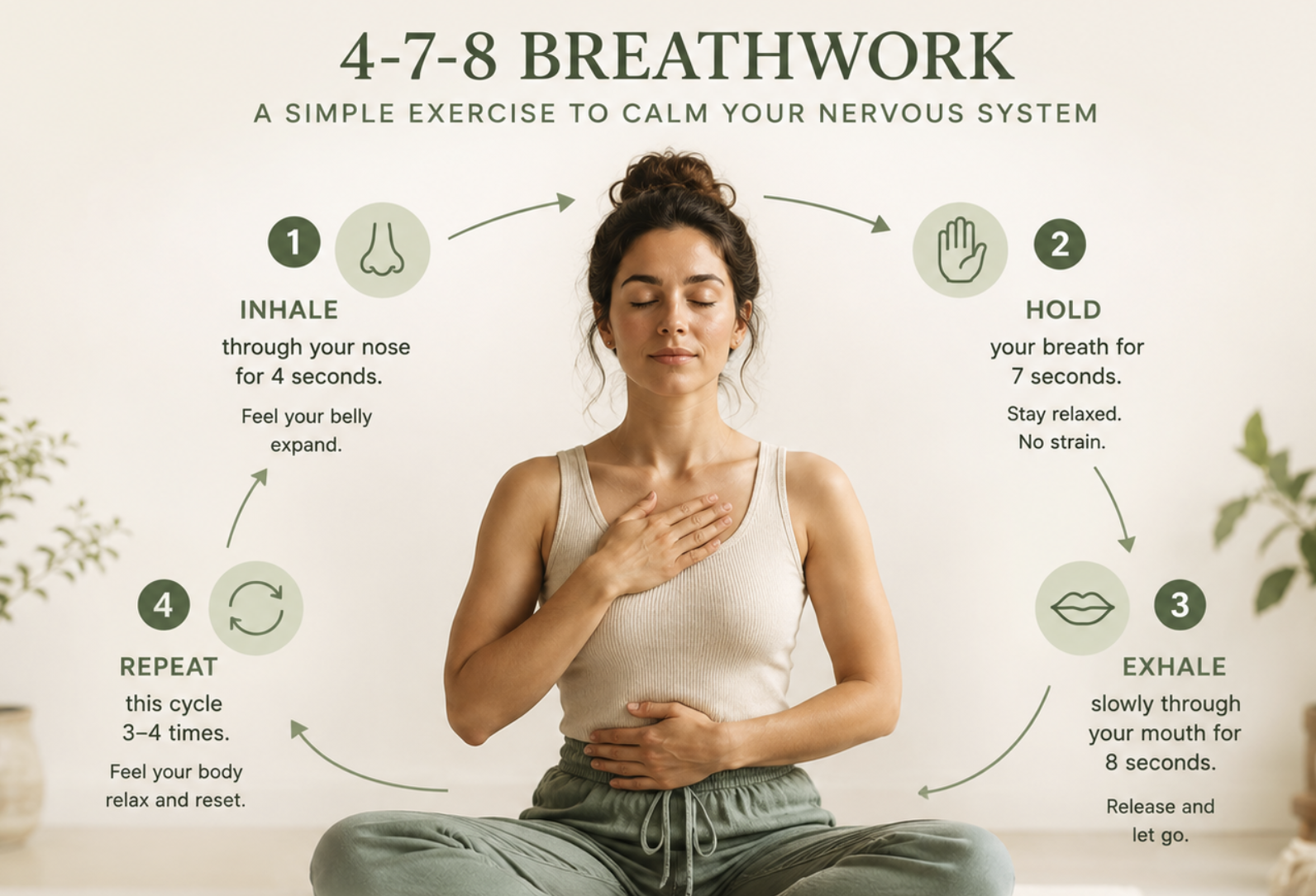
4-7-8 Breath Work
One of the techniques we use in a therapy session to help you to calm before starting.
How Hypnotherapy Can Help a Nervous System Stuck in Fight or Flight
Talk therapy and conscious techniques are valuable but they work primarily at the level of the thinking mind. And as we've seen, when the stress response is deeply embedded, the thinking mind often isn't what's running the show.
Hypnotherapy works differently. In a relaxed, focused state, the subconscious mind becomes far more accessible. This is where the deep patterns, beliefs, and threat responses live and where lasting change is possible.
Through hypnotherapy, it's possible to:
Reprocess past experiences that trained the nervous system to stay on high alert
Interrupt and reframe automatic threat responses at the subconscious level
Install new patterns of safety, calm, and self-regulation that the nervous system can begin to use as its default
Deeply experience the state of safety not just intellectually understand it, which is what the nervous system actually needs to begin to reset
Many clients describe hypnotherapy as the first time they've felt genuinely calm in years not because they were told to relax, but because something shifted underneath.
If you've been trying to think your way out of chronic stress and it isn't working, it may simply be because the answer isn't in the thinking mind. It's in working with the deeper parts of the brain that the fight or flight response calls home.
You Don't Have to Stay Stuck
If your nervous system has been running on high alert, please know: this is not who you are. It is a pattern learned, adaptive response that made sense once and that can be changed.
The brain is not fixed. Your nervous system is not a life sentence. With the right support, it is possible to feel safe in your own body again, to think clearly, to rest deeply and to move through the world without that constant low hum of dread.
That's the work we do at Next Chapter Hypnotherapy helping your nervous system find its way back to the calm and safety it was always meant to return to.
Book a free discovery call to find out how hypnotherapy could help you finally get out of survival mode and into the life you actually want to be living.