

Ski Confidence: Why Your Nerves Take Over on Slopes You Know You Can Ski
You've booked the holiday. The chalet's paid for, the salopettes are out of the loft and the group chat is already counting down.
Meanwhile you're lying awake picturing the top of a red run, legs locked, everyone else disappearing round the bend while you side-slip down on your edges.
Losing your ski confidence is far more common than anyone lets on.
Plenty of capable adults spend a week in the Alps feeling sick in the lift queue every morning and say nothing, because they assume it's a skill problem.
Whether you'd call it nerves, a wobble or a full blown fear of skiing, the cause is usually the same.
Most of the time it isn't your technique. Most nervous skiers can ski.
The trouble sits in the part of the brain that decides whether you're safe.
Why does my confidence disappear on the slopes when I know how to ski?
Deep in your brain is a very old threat detector.
I call it your caveman brain. Its only job is to keep you alive, and it's brilliant at it, but it's not very good at telling the difference between real danger and something that just feels dangerous.
Your caveman brain can't tell the difference between a polar bear and a steep, icy pitch with a drop on one side.
It fires the same alarm for both.
That alarm is adrenaline. Your heart races, your breathing goes shallow, your thighs tense up and your body pulls back away from the slope.
In skiing, leaning back is the worst thing you can do.
Your skis run faster, they're harder to turn and you feel even less in control.
Your brain takes that as proof it was right to be worried and your confidence drops a little more with every run.
That's why you can ski a blue beautifully on Tuesday morning and freeze on the same run on Tuesday afternoon when the light goes flat.
Your legs haven't forgotten anything. Your alarm system has taken over.
The infinity edge: why it feels like you'll ski off the mountain
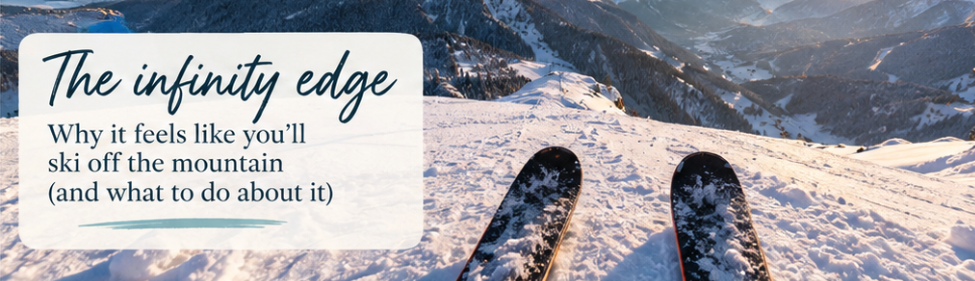
You push off from the lift, round a corner and the piste in front of you seems to stop.
There's a lip of snow, then nothing but sky and a valley a very long way down.
Skiers call this the infinity edge.
It happens where a slope rolls over steeply, so you can't see the run below until you're right on top of it.
Your eyes are telling you there's a cliff.
Your caveman brain believes them and suddenly every thought is about losing control: what if I pick up speed, can't stop and go straight over the edge?
The run is still there, carrying on below the lip, even though you can't see it yet.
A few things help in the moment.
Look for the next piste marker pole rather than staring at the horizon, because the poles show you where the run goes.
Side-slip slowly towards the lip until the slope below comes into view.
Pick your first turn before you push off, so your brain has a plan to follow instead of a drop to stare at.
What ski nerves look like
Low ski confidence tends to look the same from person to person, even though everyone thinks they're the only one:
"What if I can't stop?"
"I'm going to hold everyone up."
Tensing up at the sound of your skis scraping across ice.
Counting how many days of skiing are left before you can go home.
Taking the blue run every time and telling everyone you prefer it.
Inventing a sore knee so you can sit out the afternoon with a hot chocolate.
Worrying more about getting off the chairlift than about the run itself.
Standing at the top of a run you skied fine yesterday, because today it's icy and you can't make yourself push off.
Each of these keeps you away from the thing that makes you nervous, and in the moment that feels like relief.
The catch is that every time you avoid something, your caveman brain files it away as evidence that it was dangerous.
Next time, the alarm goes off a little sooner.
How do I get my ski confidence back after a fall or injury?
A fall can take two seconds. The memory of it can last for years.
When something frightening happens, your brain stores it with a big emotional label attached, so it can warn you if anything similar comes along.
That's useful if you've just met a bear. It's less useful if you caught an edge on a crowded piste three seasons ago and now your stomach turns every time you see a similar slope.
Lots of skiers tell me their knee healed long before their confidence did.
They're physically fine and their physio has signed them off, yet the moment their skis start to pick up speed, they're back on that slope, mid-tumble.
It's the same pattern I see in horse riders who've had a fall, which I've written about in getting your confidence back after a horse riding fall.
Your brain is still treating the fall as something that's happening now.
In sessions we can use a gentle technique called the rewind, which helps the brain process that memory so it can be stored as a past event, without the emotional charge that keeps setting off the alarm.
Is it normal to feel nervous before a ski holiday?
Completely. A lot of people feel guilty about it, because a ski trip is supposed to be the highlight of the year and it costs a small fortune.
The weeks before you go are often worse than the trip itself.
Each time you replay the worst-case scenario in your head, your brain experiences a bit of that worry as if it were real.
I explain this to clients as the stress bucket. Every anxious rehearsal adds a little more to the bucket, so by the time you land in Geneva it's already near the top.
For some people the nerves start before they've even reached the snow. If the flight out is part of the dread, my post on fear of flying covers that side of it.
Parents often have it hardest.
On a family trip you're trying to look relaxed for the kids while your own heart is pounding, and you're watching your children fly down a slope you'd rather not go near.
Can hypnotherapy help with ski confidence?
Hypnotherapy won't teach you to parallel turn.
That's your instructor's job, and good lessons matter.
What hypnotherapy can do is help with the part lessons can't reach: the alarm that goes off before you've even pushed off.
In our first session I explain exactly what your brain is doing and why, because once you understand the caveman brain, a lot of the nerves start to make sense.
From there we use hypnosis, a calm, focused state of relaxation, to help your brain settle and to rehearse the slope in your mind.
No two skiers bring me the same worries.
For one person it's the infinity edge at the top of a red run.
For another it's the scrape of ice under their skis, the drag lift, or a fall they can't stop replaying.
I take the exact moments that worry you on the mountain and write a personalised hypnosis script around them, so your session is built for your fears rather than a generic version of them.
In hypnosis you picture yourself at the top of that run, feeling your skis grip and your breathing steady, and seeing yourself turn smoothly down the hill.
Top athletes use mental rehearsal like this for good reason.
Your brain responds to a vividly imagined experience in a very similar way to a real one.
There's something you can try now, too.
At the top of a run, breathe in for a count of four and out for a count of six or seven.
A long out-breath tells your nervous system you're safe.
Then look where you want to go, down the fall line to your next turn, rather than at the drop.
What one skier said after their session
Make it stand out
Whatever it is, the way you tell your story online can make all the difference.
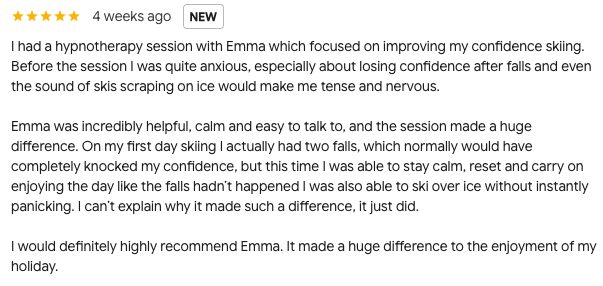
"I had a hypnotherapy session with Emma which focused on improving my confidence skiing. Before the session I was quite anxious, especially about losing confidence after falls and even the sound of skis scraping on ice would make me tense and nervous.
Emma was incredibly helpful, calm and easy to talk to, and the session made a huge difference. On my first day skiing I actually had two falls, which normally would have completely knocked my confidence, but this time I was able to stay calm, reset and carry on enjoying the day like the falls hadn't happened. I was also able to ski over ice without instantly panicking. I can't explain why it made such a difference, it just did.
I would definitely highly recommend Emma. It made a huge difference to the enjoyment of my holiday."
How many sessions do I need before my trip?
Everyone's different, so I won't give you a number until we've talked.
As a rough guide, it helps to start four to six weeks before you fly. That gives you time for the sessions to settle in and leaves room for a practice run before the real thing.
Practise closer to home
If you live in the Midlands or the North, you don't have to wait for the Alps to put your new confidence into practice.
Swadlincote Snowsports Centre in South Derbyshire, Chill Factore in Manchester and Snozone at Castleford are all within reach.
A couple of runs on a familiar slope after your sessions gives your brain new evidence that skiing can feel fine, which is exactly what it needs.
Online hypnotherapy for nervous skiers, wherever you are
I work with clients online across the UK and worldwide, and online hypnotherapy works just as well as sitting in a room together.
You can have your sessions from your own sofa, whether you're in Derbyshire, London or already counting down to a season in Val d'Isère.
I'm Emma Fogg, an award-winning hypnotherapist, winner of Best Alternative Therapy Provider at the 2026 Derbyshire Business Awards, registered with the CNHC and the NCH, with 100% five-star Google reviews.
If nerves are taking the shine off your ski holiday, book your FREE 30 minute discovery call and we'll talk it through, no pressure.
You can also read more about hypnotherapy for confidence and how online hypnotherapy works.