

Why willpower alone rarely works for stopping smoking

"I just haven't got the willpower."
I hear that sentence in almost every discovery call about smoking.
It is worth pulling apart, because it is doing you a disservice on two counts. It is not accurate, and it puts the problem somewhere you cannot do anything about it.
You have plenty of willpower. You use it constantly. You get up when you would rather not, you do things you do not fancy doing, you hold your tongue when you would love not to. Nobody gets through an ordinary week without it.
So the question is not whether you have any.
It is why this particular thing keeps beating it.
What willpower actually is
Willpower is not a character trait.
It is closer to a function, and it lives in the newest, most sophisticated part of your brain, the part that plans, reasons, weighs things up and overrides impulses.
That part is brilliant.
It is also expensive to run and it has a limited daily budget.
It is at its strongest when you are rested, calm, fed and not under pressure.
It is at its weakest when you are tired, stressed, hungry, upset, rushed or have already spent the day making decisions.
Now hold that next to the moments you actually smoke.
Nobody's hardest cigarette is at ten o'clock on a Sunday morning after a good night's sleep.
It is at the end of a bad day. It is after a row. It is at eleven at night when everything has gone wrong. It is in the middle of a work crisis.
Which means the thing you are relying on is at its lowest exactly when you need it most.
That is not a flaw in you. That is a design mismatch.
The other part of the brain, the one that gets there first
Underneath the reasoning part sits something much older and much faster, and its job is to keep you alive and to run anything you do often enough that it can be automated.
It does not deliberate.
It does not weigh up the pros and cons. It pattern matches and it acts.
This is the part that has learned, over however many years, that a particular moment goes with a particular action.
The kettle. The car. The pub garden. The phone call from that one person.
By the time the reasoning part of your mind has caught up and started assembling the argument about your lungs and your children and how much this costs a month, the cigarette is already lit.
That is what people are describing when they say "it was in my hand before I knew what I was doing".
It is not a figure of speech. Two different systems are involved, and the faster one moved first.
Why stress makes it so much worse
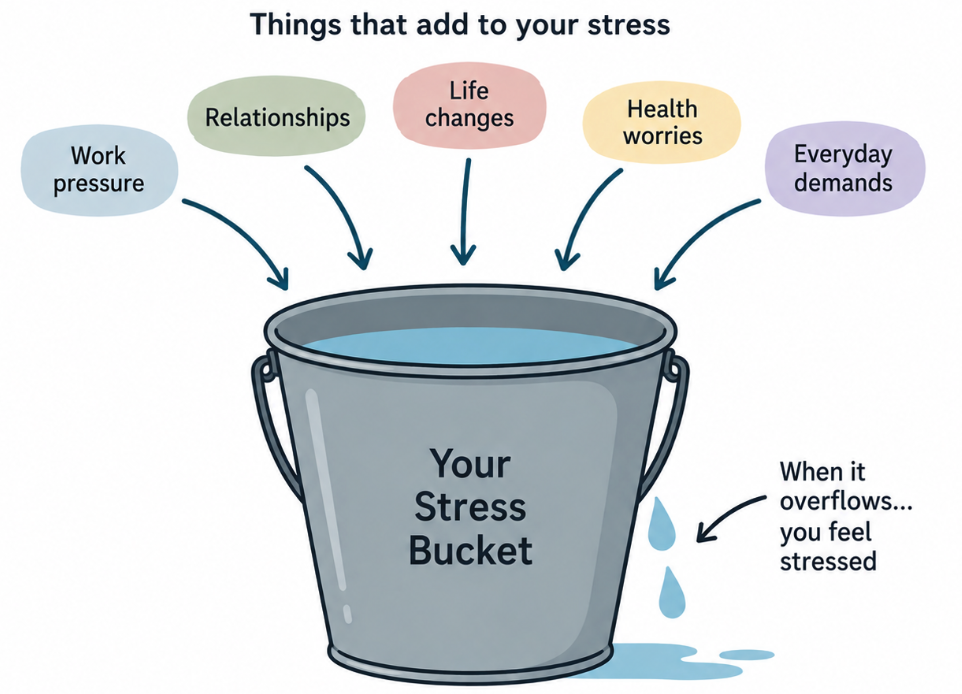
In Solution Focused Hypnotherapy we talk about the stress bucket, and it is useful here.
Everything you are carrying goes into the bucket. Work, money, family, the broken thing you have not got round to, the conversation you are dreading, the fact you slept badly. Ordinary life, none of it dramatic.
When the bucket is low, you have full access to the reasoning part of your brain. You are patient, you think clearly, you make decisions you are pleased with the next day.
When the bucket fills up, you get pushed down into that older, faster part instead. Everything feels more urgent. You are shorter with people. You reach for the familiar things, because the familiar things are what the automatic brain has on file.
So a stressful fortnight is not a neutral fortnight in which you happen to have less willpower. It is a fortnight where you are operating out of the exact part of your brain that has smoking stored in it as a solution.
This is why people so often stop successfully and then start again the week something goes wrong. Nothing about their commitment changed. Their bucket filled up.
What willpower is genuinely good for
I am not telling you willpower is useless, and I would be wary of anyone who did.
Willpower is excellent for decisions.
It is what gets you to pick a date, book a session, throw out the ashtray, tell people you are stopping, and put your money down.
Every one of those is a single deliberate act by the reasoning part of your mind, taken while the bucket is low, and willpower handles all of them beautifully.
What it is not good at is holding a line for twenty eight consecutive days, in every mood, at every hour, through whatever the month throws at you.
So what works better?
Change the situation, not just the intention
Willpower gets used up by repeated exposure.
Every time you are in a smoking moment and get through it, it costs you something.
So reduce the number of times it has to fire.
Change the route if the route is a trigger.
Move where you stand at break. Have the first fortnight's evenings look different to your usual evenings. Tell the people who will otherwise offer.
This is not avoidance, it is not weakness, and it is not forever.
It is spending less of a limited resource in the fortnight you most need it.
Empty the bucket rather than white knuckling a full one
Anything that genuinely brings your stress levels down makes stopping easier, because it keeps you up in the part of your brain that can actually choose.
Sleep, daylight, walking, talking to someone, and doing things you enjoy on purpose rather than as an afterthought.
It sounds almost too simple to be worth writing down.
It is the single most underused thing in stopping smoking.
Aim at something rather than away from something
"Don't smoke" is an instruction to not do a thing, and the automatic brain is poor at those.
It is far better at heading towards things.
So get specific about what you are heading towards.
Not "being healthier".
What is different in six months, in enough detail that you could easily describe it.
Work on the association itself
All of the above makes the fight fairer.
None of it changes the underlying link between the moment and the hand.
To change that, you need to be working in the same part of the mind the link lives in, and you cannot get there by deciding harder.
Deciding is the other system. That is the whole problem.
Where Hypnotherapy fits
Hypnosis is a focused, deeply relaxed state, and you have been in it many times without calling it that.
Driving a familiar road and not remembering the last two junctions. Being so absorbed in something that you did not hear someone come in.
In that state the busy, analytical, arguing part of the mind quietens down, and the mind is more open to new suggestion.
Which means it is one of the few approaches that works at the level the habit is actually running at.
In a Solution Focused session we talk first, mapping where smoking sits in your day and building a detailed picture of what you want instead, and then we use hypnosis to reinforce that picture and loosen the automatic link.
I want to be honest about the process.
Hypnotherapy can carry a lot of the weight but it cannot carry all of it.
You still have to walk past the shop, do the homework and make a conscious effort.
Hypnotherapy is not mind control and requires collaboration.
Frequently asked questions about Quitting Smoking with Hypnosis
Is stopping smoking really just about willpower?
No. Willpower is a function of the reasoning part of the brain, and it is at its weakest when you are tired, stressed or under pressure, which is exactly when most people smoke.
The habit itself runs in a faster, more automatic part of the mind that acts before the reasoning part has finished forming a sentence.
Why can I stop for a few weeks and then start again?
Usually because something filled your stress bucket.
When stress levels rise, you spend more time in the automatic part of the brain, and that is the part with smoking stored in it as a familiar response.
Nothing about your commitment changed. Your circumstances did.
Does hypnotherapy mean I do not need any willpower?
No, and be careful of anyone who tells you otherwise. Solution Focused Hypnotherapy asks something of you after the session a commitment and some homework.
What it does is stop you having to rely on willpower alone, in every moment, for a month.
Will I be asleep or out of control during hypnosis?
No. Hypnosis is not sleep and it is not unconsciousness. You stay relaxed and aware, you can hear me, you can speak, and you can open your eyes whenever you want.
Most people describe it as the pleasant floaty state just before you drift off, held for a while.
If willpower has not been enough
Start with the free thirty minute discovery call.
No pressure and no sales pitch, just a conversation about whether this is the right thing for you.
If it is not, I will tell you.
Or message me on WhatsApp on 07885 571599 and ask me anything.
Sessions in person near Long Eaton in Derbyshire, or online anywhere in the UK and worldwide. If you want a date before 1 October, it is worth asking now.